
How to Get More Google Reviews for a Plumbing Business
Most shops lose reviews to bad timing and worse wording. Here's the trigger, the text, and the one rule that keeps an automated ask from backfiring on a bad job.
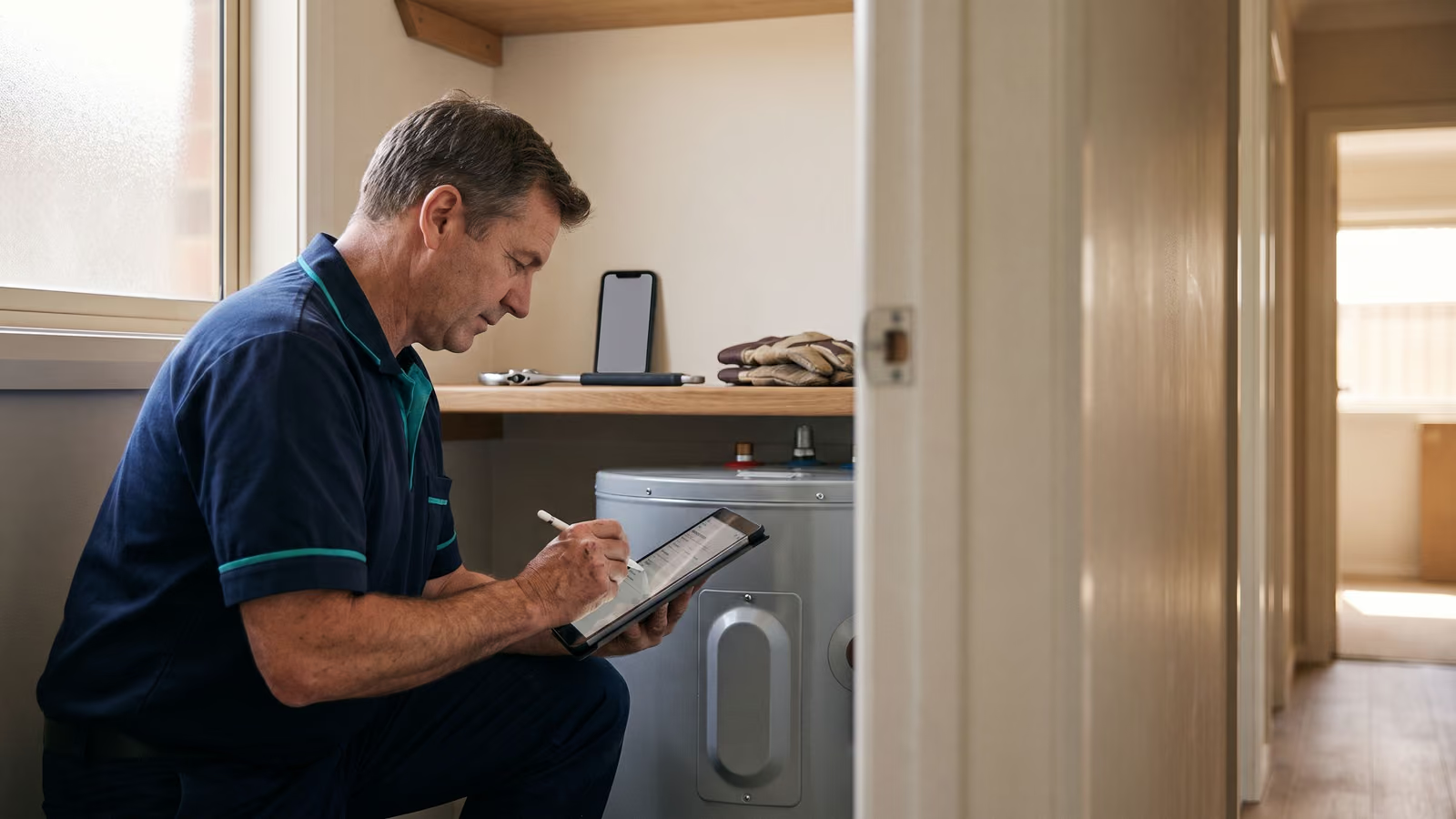
You finish a water heater swap, the customer thanks you, pays, and you drive off. A week later you remember you meant to ask for a review. You don't text them now because it feels late and a little awkward. So the job that went perfectly leaves no trace on your Google profile, and the one customer who was annoyed about the scheduling window writes two paragraphs about it.
That's how most shops end up with eleven reviews and a competitor down the road has ninety.
Getting more Google reviews for a plumbing business comes down to when the ask goes out, what it says, and who it never goes to. By the end of this page you'll know how to set that up so it runs without you remembering.
Ask customers only after someone signs the job off as done
Most review automations fire on the wrong event. The office generates an invoice, the system sees a billing record, and out goes a text asking how the crew did. Half the time that customer is still waiting on a part, or the tech is coming back Thursday to finish the trim-out, or the invoice went out early because the office batches them on Fridays.
An invoice tells you the office did its paperwork. A calendar slot passing tells you a time went by. Neither one tells you the work is finished and the customer is happy.
The trigger has to be a completed job that a human signed off on. A tech closes it out in the field, the notes and photos are attached, the office sees it's done. That's the event. Everything else is a guess.
This is the single detail that decides whether automation helps you get more Google reviews for your plumbing business or embarrasses it. We build the ask as the fourth automation in a shop's setup, after missed-call text back, quote follow-up and invoice reminders, and it's the one we're most careful with for exactly this reason.
Two things to check this week:
- What event does your current review request fire on? If it's tied to billing or to a scheduled appointment ending, it's catching unfinished work.
- Does anyone mark a job complete, or does it just fall off the calendar? If there's no completion step, there's nothing clean to trigger from.
Fix the completion step first. The ask can wait a week. A request sent to a customer with a hole still in their wall costs you more than a missing review does.
Text requests get answered, email requests get buried
Most customers booked the job by text. They texted to confirm the window, they texted the tech when he was out front, they texted a photo of the water heater label. That thread is already open on their phone with your shop's name on it.
Send the review ask into that same thread, from that same number, and it reads like the person who just fixed their faucet. Send it as an email and it reads like a list. One gets answered in the kitchen. The other sits under a receipt and two newsletters.
That's the whole operator detail, and it's easy to get wrong. A lot of shops run review requests out of a separate marketing tool with a different sending number, or a generic one. The customer sees an unknown number asking them for a favor and deletes it, same as any other cold text.
When you compare text/email requests side by side, the thing doing the work isn't the channel by itself. It's the continuity. Same number, same thread, same name they already know.
Check this week: pull up the last five jobs you completed and see whether your review ask landed in the booking thread or somewhere else. If it came from a different number, that's the first thing to change.
What to say in the ask, and where the review link goes
Short beats polite. Two sentences, a direct ask, and the review link right there so nobody has to go hunting for your page.
The parts that matter:
- Name the job, so they remember which visit you mean
- Ask for the review in plain words, right up front, before any paragraph of thanks
- Paste the review link on its own line
- Add one line asking them to pass your number along if they know someone who needs a plumber
Don't ask them to pick a star rating, hint at what you're hoping for, or offer a discount for posting, since incentives are prohibited under Google's review rules and can get the review pulled. The link takes them straight to the form, and Google handles the rest.
The referral ask rides along in the same message. One text, two jobs.
The text script, plus a QR code on the paper invoice
Here's a version you can copy and change to fit your shop:
> Hi Dana — Marcus here from Ridgeline Plumbing. Glad we got the water heater sorted out yesterday. If you've got 30 seconds, a quick Google review really helps us out: [review link] > > And if anyone you know needs a plumber, feel free to pass my number along.
Name the technician who was actually in the house. "Marcus here" reads like a person; "Ridgeline Plumbing Customer Care" reads like a mailing list. If you have a few technicians, the automation should pull the name off the job record so the right one signs the text.
Keep the review link on its own line, and if you leave a paper invoice behind, print a QR code on it that opens the same page. Thumbs find it faster, and it doesn't get swallowed by the sentence around it.
Say what you fixed. Water heater, slab leak, kitchen stack. People book plumbers once and forget the company name a week later.
When a customer replies with a problem, stop the sequence
Some people answer "sure, sending it now." Others answer "actually, the drain is slow again." The automation has to know the difference, and the safe rule is simple: anything that isn't a clear yes stops the sequence and pings a person.
No second nudge. No "just following up!" three days later. A customer who just told you something is still wrong and then gets another review request has learned exactly how much of your shop is a robot.
Route that thread to whoever handles the phone, with the job notes attached so they're not starting cold. A reply within the hour usually turns the complaint back into a finished job, and sometimes into a review anyway.
This is the part most owners skip, and it's the part that protects trust. Customers forgive a slow drain. They don't forgive being ignored by an auto-text.
Don't ask for a star rating on a job that went sideways
A callback on a water heater that's still leaking does not need a text asking for five stars. That text will get answered, and not the way you want.
So the trigger matters more than the message. A review ask should fire off a job that a human marked finished, not off a calendar slot passing or an invoice being generated or a status flipping to "complete" because the tech closed out on the way to the next call. Those are automatic events. They happen whether the work went well or not.
What you want is one deliberate step: the tech or the office looks at the job, confirms it's done and documented, and signs off. That sign-off is what starts the sequence. Everything else stays quiet.
It's a small amount of friction and it's worth it. A plumbing business runs on trust that's built one house at a time, and a tone-deaf automated text on a bad job undoes more than a good review adds. The customer who was willing to give you another shot now knows nobody read the notes.
Set it up this week by looking at what currently marks a job complete in your system. If anything about it is automatic, change it. One checkbox, one person, one moment where someone decides this job is actually done.
Then let the automation do the rest.
How to reply to reviews that aren't good ones
Some will land. A tech arrived in the afternoon window when the customer heard morning. A price came in higher than what they remember being told on the phone. Sometimes the complaint is fair and sometimes it isn't, and the public reply works the same way either way.
Write for the next person reading, not for the customer who posted. That one decision changes everything about the tone. The customer is upset and may not come back. The homeowner comparing three plumbers on Google reviews is going to read your reply and decide whether you sound like someone who handles problems.
What a calm reply looks like:
- Name the specific thing. "You were scheduled for a two-hour window on Tuesday and our tech got there at 4." Vague sympathy reads like a script.
- Say what happened, if you know. A truck broke down. A job before yours ran long. People accept real reasons.
- Say what you're doing about it. Not a promise to "do better" — the actual change, like calling ahead when the day slips.
- Give a way to reach a person. A name and a number.
- Stop there. Don't argue the invoice line by line in public.
On a pricing dispute, pull the quote before you reply to reviews. If the number on the quote matches the invoice, say so plainly and offer to send them the copy. If it doesn't, you have a different problem and the review is the least of it.
A steady flow of new reviews pulls a star rating back up faster than any reply does. Keep the ask running while you handle this one.
Reviews are one part of showing up in Google search
A plumbing company with fifty good reviews and the wrong phone number on four directories is still hard to hire. Google reads your business name, address and phone number across the web and compares them. When they don't match, it has less reason to trust any of it. That's NAP consistency, and it's the quiet half of local SEO that nobody wants to sit down and do.
Start with your Google Business Profile. If you've never claimed it, do that this week — Google will verify you by postcard, phone or video, and until that's done you can't control what shows. Check the hours, the service area, the categories, and the phone number that actually rings in your office. Then check the old listings: Yelp, Angi, the chamber, the supply house directory somebody added you to in 2016.
We run this through Moz Local, which pushes one set of business details out to the directories and flags the ones that disagree. It's not magic. It's a way to stop fixing the same wrong address eight times a year.
Reviews and listing accuracy work on the same thing: whether you turn up in the map pack when somebody searches for a plumber nearby. The Map 3-Pack is three slots. Accurate details keep you eligible; reviews help you look like the obvious call.
How many Google reviews a plumbing business actually needs
There's no number that flips a switch. Owners ask whether they need a hundred, or a thousand, and the honest answer is that a count by itself doesn't do much once you're past the point where a customer can see you've done real work for real people.
What matters more is the pace. A shop with reviews from last week looks open, busy and current. A shop whose newest review is from two summers ago reads as closed, even with a pile of old ones. Google weighs recency too.
So aim for a trickle that never stops: a few reviews every week, forever, coming off finished jobs.
Your star rating follows the same logic. A perfect score with a handful of reviews is easy to dismiss. A strong average built over years of jobs is hard to argue with, and the occasional four-star mixed in makes the rest believable.
Set the ask to run on every completed job, and a plumbing business will get more Google reviews without anyone keeping count.
Common questions about getting more Google reviews
What's the fastest way to increase the number of Google reviews a shop has?
Stop asking by hand. Pick one trigger — a job marked complete and signed off by a person — and have the ask go out as a text in the same thread the customer used to book. That's it. The volume comes from running it on every finished job instead of the ones you happen to remember.
Does asking for reviews bring in more work?
Indirectly, and it's one of several things pulling. Getting more Google reviews helps a plumbing business show up and look current when someone searches, but your listing has to be accurate in the first place. We handle that side through Moz Local, so the hours, service area and categories match everywhere a customer might find you. Reviews and listings work together.
Can I ask for a referral at the same time?
Yes. The same text can ask the customer to pass your number along. People who just had a good experience are the only ones who will.
If you want the ask wired into your job flow so it fires off completed work and nothing else, book a New Project Consultation.

About the author
Chris Hobbick
I build and fix websites, Shopify stores and business software. I work directly with business owners to understand the problem and agree on the work and price.
Meet Chris →Keep Reading
More Practical Reading.
Real articles on business systems, websites and automation.